


TL;DR
The COF-C03 exam went live in February 2026 and has shifted toward scenario-based questions that test judgement and feature discrimination, not pure recall.
Most candidates fail by memorising features instead of learning to tell near-identical features apart (Snowpipe vs Snowpipe Streaming, Result Cache vs Warehouse Cache, Masking vs Row Access).
Study to the domain weightings, not evenly. Architecture (31%) and Performance (21%) together make up over half the exam.
The single biggest exam-day mistake is misreading the scenario. Read the stem twice and identify the one requirement being tested before you look at the answers.

Introduction
I have watched capable engineers walk into the SnowPro Core exam having memorised every feature in the documentation, and walk out having failed.
That used to be rare. With the COF-C03 version, it is becoming common.
The reason is simple: knowing each feature no longer guarantees you can answer the question, because the exam now wants to know whether you can choose the right feature in a realistic situation.
If you are searching for how to pass the SnowPro Core COF-C03 exam, this is the shift you need to understand first. The exam has moved away from “define this” toward “here is a scenario, what would you do.”
That is good news if you have real hands-on experience, and a trap if you have only revised flashcards.
Having spent nearly five years at Snowflake as a Senior Solution Architect and Training Course Instructor, and having helped author and review exam questions, I want to show you where the marks are actually lost and how to study so you pass on the first attempt. Let us start with what the exam tests today.
What the COF-C03 Exam Actually Tests in 2026
The format at a glance
The COF-C03 exam is 100 questions in 115 minutes, a mix of multiple-choice and multiple-select. The passing mark is a scaled 750 out of 1000 (roughly 75%), it costs $175 USD, and it is delivered through Pearson VUE, either at a test centre or online with a proctor.
Your certification stays valid for two years, after which you recertify through the Snowflake Continuing Education.
A practical point that calms a lot of nerves: there is no penalty for a wrong answer. Answer every question. If one is slowing you down, mark it and move on. In three attempts at this exam over the years, I have never run out of time, so do not rush and misread a scenario to save thirty seconds.
The five domains and their weightings
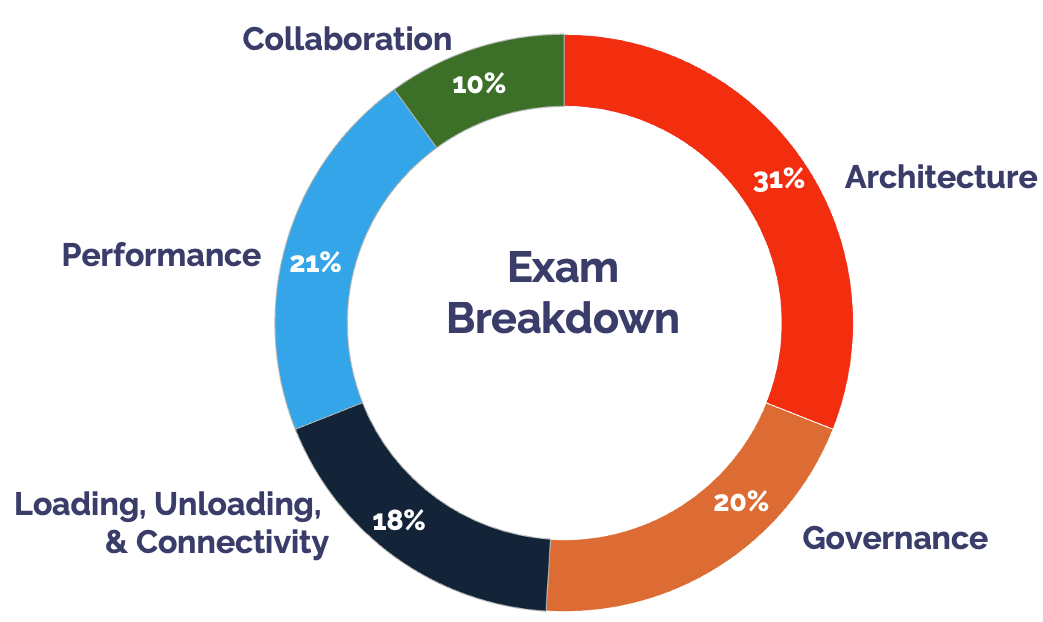
The exam is organised into five domains, and the weightings are different for each one. This matters more than anything else in your study plan.
| Domain | Weighting |
|---|---|
| 1.0 Snowflake AI Data Cloud Features and Architecture | 31% |
| 2.0 Account Management and Data Governance | 20% |
| 3.0 Data Loading, Unloading, and Connectivity | 18% |
| 4.0 Performance Optimization, Querying, and Transformation | 21% |
| 5.0 Data Collaboration | 10% |
Architecture and Performance together account for more than half the paper. If you are short on time, that is where it should go.
The full breakdown is in the official SnowPro Core COF-C03 exam study guide, which is worth downloading less for the topic list and more for the documentation links it points you to.
However, be warned - it's very concise! I personally found it really difficult to extract the list of subjects you need to know - but at least you don't have too!
What changed from COF-C02
If you studied from older COF-C02 material, be careful. The biggest change is the weight given to AI and application features. Y
ou are now expected to understand Snowflake Cortex — the AI SQL functions, Cortex Search, Cortex Analyst, and Document AI — along with Snowflake ML, Notebooks, Streamlit in Snowflake, and Snowpark.
Beyond AI, several newer features now appear in scope: Gen 2 standard warehouses, Apache Iceberg and Dynamic tables, Git integration, the Trust Center, automatic data classification, privacy policies, secondary roles, and Snowpipe Streaming.
The architecture, security, and loading fundamentals are still the backbone of the exam, but the surface area has grown, and it has grown in the direction of applied, scenario-style questions.
Why Do Candidates Fail the SnowPro Core Exam?

They treat it as a recall test when it is a discrimination test
The most common pattern I see is candidates who can recite definitions but freeze when a question describes a situation.
The COF-C03 exam rarely asks “what is X.” It asks “given this situation, which of these four valid-sounding options is correct.” That is a different skill, and you build it through practice and hands-on work, not memorisation.
They confuse near-identical features
This is where the marks quietly disappear. Snowflake has many features that sound similar and solve subtly different problems. The exam is built to test exactly these distinctions. A few that catch people out:
Snowpipe vs Snowpipe Streaming — micro-batch file ingestion versus low-latency row-level streaming.
Result Cache vs Warehouse Cache vs Metadata Cache — three different caches with three different rules. Knowing the Snowflake result cache conditions cold is worth several marks.
Dynamic Data Masking vs Row Access Policy — one controls what you see within a column, the other controls which rows you see at all.
Data classification vs object tagging vs masking — detecting and labelling sensitive data is a different feature from controlling who can read it.
If you cannot explain the difference between each pair in one sentence, that is a gap to close before exam day.
They get caught by domain-crossover questions
A question that looks like a performance problem may actually be testing architecture.
A scenario about a “slow query on a growing table” might be steering you toward clustering, warehouse sizing, or the search optimization service — three different answers depending on the detail in the stem.
Read the whole scenario before you decide which domain it belongs to.

A Domain-Weighted Study Plan With Time Estimates
Allocate study time to the weightings, not evenly
Spend your time where the marks are. A rough split that works:
Architecture and storage (31%) — the three-tier architecture, editions, object hierarchy, micro-partitions, table and view types. Start with Snowflake’s unique architecture.
Performance and transformation (21%) — query profile, caching, clustering, materialized views, query acceleration. Work through proven Snowflake performance tuning techniques.
Account management and governance (20%) — RBAC, the role hierarchy, authentication, masking, tagging, resource monitors. The Snowflake role-based access control design guide covers the part people find driest.
Loading and connectivity (18%) — stages, file formats, the COPY command, Snowpipe, connectors. See the methods for loading data into Snowflake
Data collaboration (10%) — secure data sharing, cloning, Time Travel, the Marketplace, clean rooms.
A realistic four-to-six week schedule
For someone with around six months of hands-on Snowflake experience, four to six weeks of focused study is realistic.
Spend the first two weeks on architecture and performance, the next two on governance and loading, and the final week on collaboration plus full-length practice tests.
The key is the loop in the next point.
Ready to study with a course built around the exam traps?
My SnowPro Core COF-C03 course covers every domain in the official exam guide — structured around the question patterns and feature distinctions that decide pass or fail, not a tour of the entire Snowflake platform.
See the course and current offer
Return to the docs and re-lab anything under 70%
Take a timed practice test, then look only at what you got wrong.
Any domain scoring under 70% gets a “return to documentation, then re-lab it” cycle before you move on.
There is no substitute for doing the thing in a free trial account. Reading that the COPY command tracks loaded files using table metadata is one thing. Watching a re-run load zero rows because the files were already loaded teaches it permanently.
How Should You Approach Scenario-Based Questions?

Read the stem twice, then identify the single requirement
Before you look at the answers, decide what the question is actually asking. Scenario questions bury the real requirement inside context.
Strip the context away and ask: what is the one thing this person needs to achieve?
Eliminate the “almost right” distractor
Well-written exam questions deliberately include options that are valid Snowflake features but wrong for this scenario. On multi-select questions there are often two strong candidates and one that is subtly wrong.
Your job is to eliminate the option that solves a different problem.
A worked example
Consider a scenario: a compliance team needs to automatically detect and label sensitive customer data spread across many tables. Four plausible features present themselves:
Data classification,
Object tagging,
Dynamic data masking
A Row access policy.
Three of these are real and useful, but only one automatically detects and labels.
Object tagging is manual. Masking and row access policies control visibility, not discovery.
The answer is data classification. The trap is that all four are correct Snowflake features, so recall alone does not help. You have to match the feature to the verb in the requirement: “detect and label.”
The same discipline applies to compute. Watch how the requirement changes the answer:
-- Requirement: complex queries on more data, finishing faster
-- This is a SIZING problem -> scale UP
ALTER WAREHOUSE my_wh SET WAREHOUSE_SIZE = 'LARGE';

-- Requirement: more concurrent users at peak, queries already fast enough
-- This is a CONCURRENCY problem -> scale OUT
ALTER WAREHOUSE my_wh SET MIN_CLUSTER_COUNT = 1, MAX_CLUSTER_COUNT = 5;
Both statements are valid. Only the requirement tells you which is correct.
What Should a Good COF-C03 Training Course Cover?

Trap-awareness over completeness
A good course does not try to teach you the entire Snowflake platform. It teaches you precisely what the exam tests, and it spends its time on the feature distinctions that decide pass or fail.
Completeness for its own sake adds anxiety and wastes your study hours.
Scenario practice with explanations for the wrong answers
Practice questions are only useful if they explain why the wrong options are wrong. That is how you build the discrimination skill the exam demands.
A practice test that only confirms the right answer teaches you far less than one that walks you through why the three distractors fail in that scenario.
Coverage of the new AI surface area, at exam depth
The course should cover Cortex, Snowflake ML, Notebooks, and Snowpark to the depth the exam asks — conceptual understanding and feature selection — without dragging you into implementation detail that will not be tested.
Knowing when to reach for Snowpark over a SQL UDF matters. Memorising every Cortex function signature does not.
A note on my earlier guide. If you have read my article 10 proven methods for Snowflake certification, the advice on hands-on practice, free versus paid training, and using Udemy practice tests all still holds.
The one part that has changed is the exam format itself. That guide described an exam that was almost pure knowledge with few scenario questions. COF-C03 is the update to that picture: the scenario style is now central, which is exactly why this article exists.
Conclusion
Passing the SnowPro Core COF-C03 exam in 2026 comes down to three things.
Study to the domain weightings so your time lands where the marks are.
Train your ability to tell near-identical features apart, because that is what the scenario questions are really testing.
On the day - relax. Slow down enough to read each scenario properly before you commit to an answer.
SnowPro Core COF-C03: Concepts, Traps and Strategy
To help Data Engineers pass the SnowPro Core Certification exam, I've written a dedicated training course. Unlike general purpose training, this is an exam-led course covering each domain in the official study guide and includes
30+ hands-on labs so you can practice subjects your not familiar with
300+ practice questions mapped to the official domains, with explanations.
5 Summary Guides - One for each domain, and a set of cheat sheets to read the day before the exam. Absolutely priceless!
Enrol now and see the current offer
A Final Question...
Which feature distinction trips you up most — Snowpipe versus Snowpipe Streaming, or the three caches?
Leave a comment and I will cover it.
About the author
After 30 years of experience building multi-terabyte data warehouse systems, I spent five years at Snowflake as a Senior Solution Architect, helping customers across Europe and the Middle East deliver lightning-fast insights from their data.
In 2023, he joined Altimate.AI, which uses generative artificial intelligence to provide Snowflake performance and cost optimization insights and maximize customer return on investment.
Certifications include Snowflake Data Superhero, Snowflake Subject Matter Expert, SnowPro Core, and SnowPro Advanced Architect.
Comments
Join the discussionI was a bit nervous before taking the COF-C03 exam, but a friend recommended Certs4Future, and it really helped. The practice questions gave me a better understanding of the exam format, and I passed with confidence. Glad I used it for my preparation.


